

Healthcare & Medtech
Custom Healthcare Software Development Services
Build digital products that support patients, help care teams work more efficiently, and turn health data into useful insights.
Our healthcare software development services cover AI strategy and validation, product design, engineering, and maintenance. We help healthcare providers and Medtech companies turn complex ideas into useful digital products.
Let’s talk about your project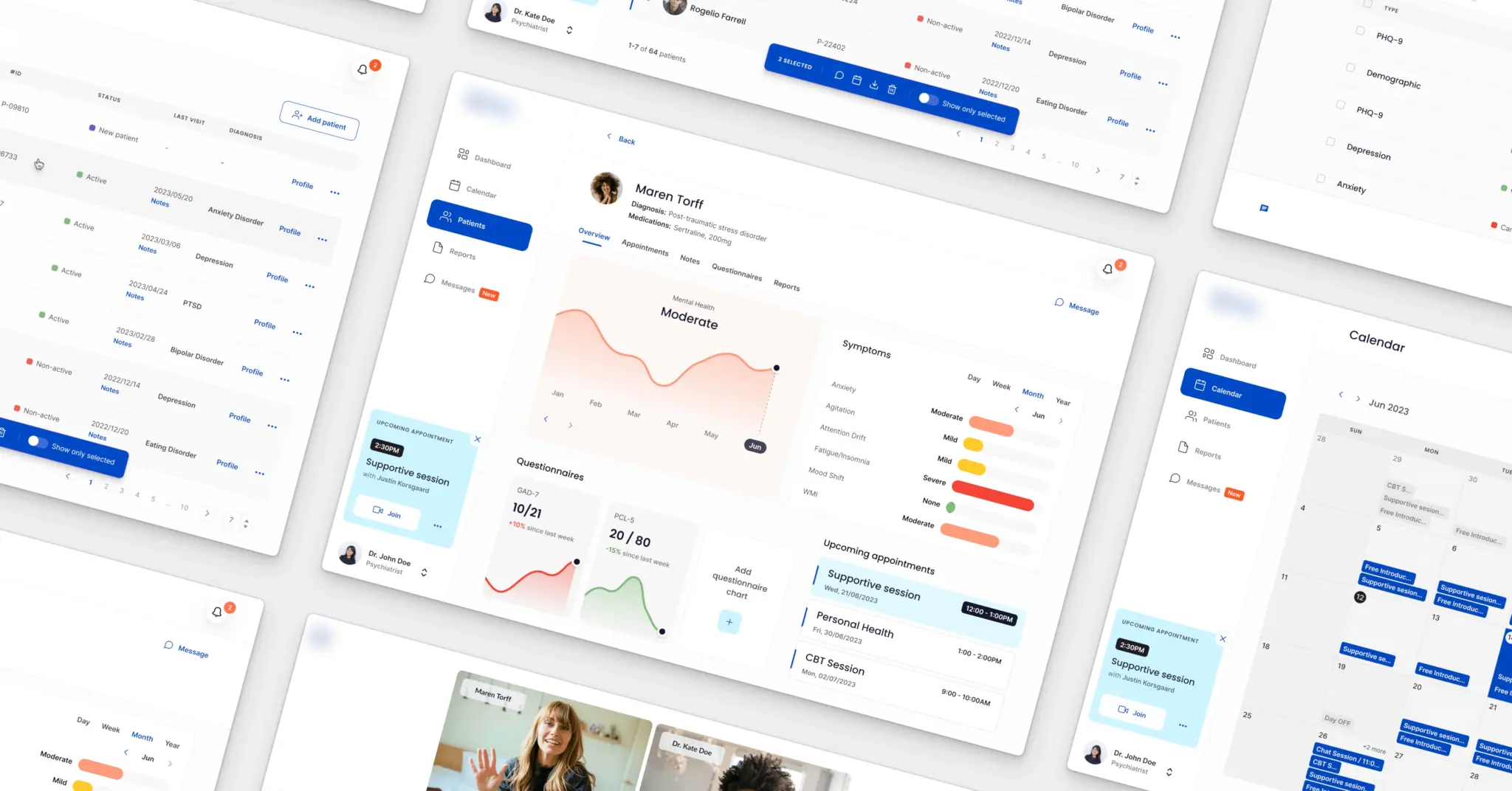
You care for people. We help you build the technology.
Healthcare technology needs to work for the people who depend on it. As a healthcare software development company, we bring together AI engineering, medical software development, interactive data visualization, and UX design to build useful products around real care workflows.
Whether you are improving an existing service or building a new Medtech product, start with the problem you need to solve.
Custom healthcare software development around your needs
Bring together the capabilities your patients, care teams, and business need.

Healthcare AI solutions
Explore predictive analytics, assistants grounded in verified knowledge, and tools that extract insights from patient interactions. Validate outputs against task-specific criteria and define where human review is required.

Medtech software development
Develop patient portals, appointment scheduling, medical protocols, and tools that help teams gather and organize information. Connect new capabilities with existing systems and workflows.

Data visualization and decision support
Make complex information easier to navigate with interactive dashboards, diagrams, and workflow tools. Help clinicians and coordinators understand patient journeys and service demand.

Product strategy and UX design
Prioritize opportunities by expected value, effort, and feasibility. Design accessible interfaces around the needs of patients, healthcare professionals, and administrators.
Have a healthcare challenge in mind? Let’s find the right next step.
Talk your vision throughTake a look at the healthcare projects we worked on
From patient platforms to AI assistants and demand forecasting. Explore the products, challenges, and decisions behind our work.
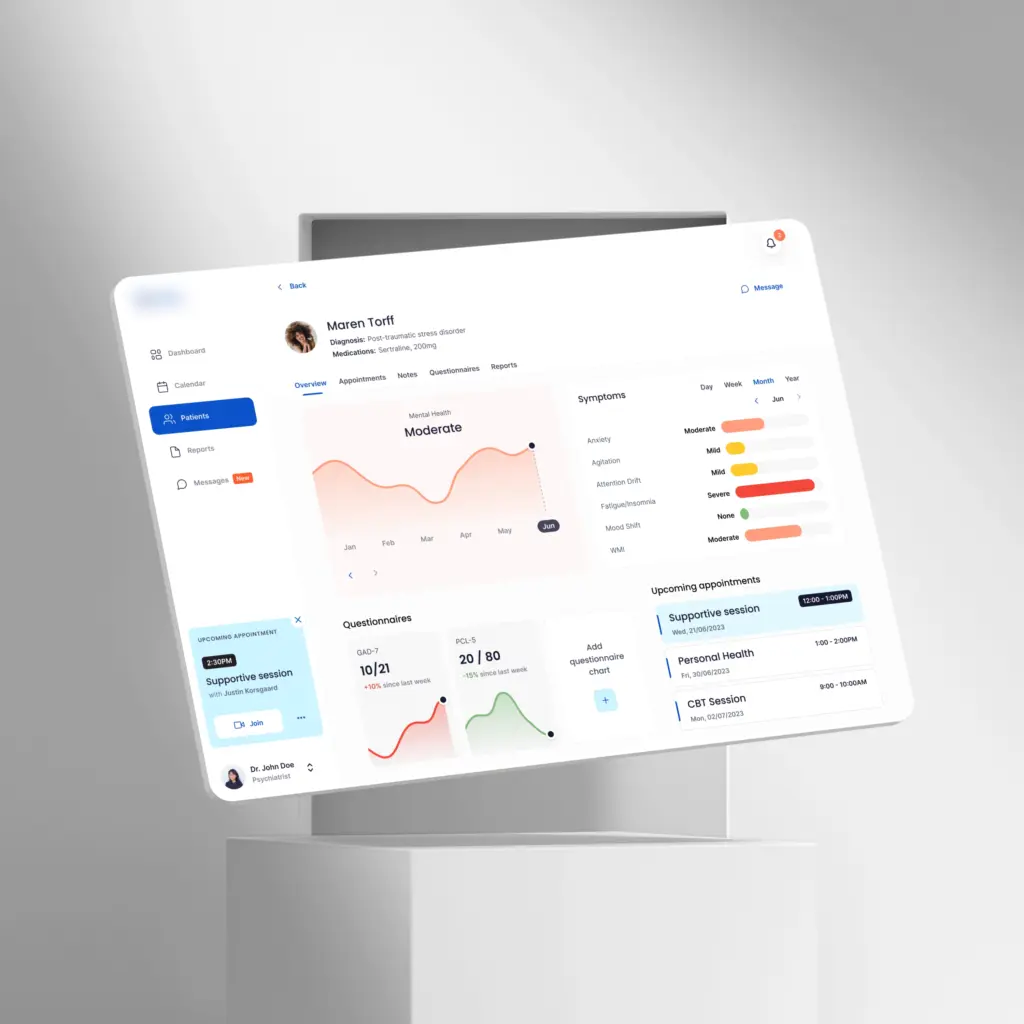
A platform for mental health assessment
An AI-ready MVP for clinicians and patients
We helped a mental health startup build the foundations of a web platform, including registration, consent collection, patient dashboards, and embedded user tasks.
Our work covered front-end development, UX, and data flows, with continued support as the product evolved.
Read more
Forecasting demand for cancer treatment
A proof of concept in three weeks
For a UK-based healthcare services company, we tested whether historical NHS referral data and public data could support demand forecasting for cancer treatment.
The proof of concept validated technical feasibility and achieved over 80% accuracy in the initial evaluation. The work focused on helping hospitals plan capacity.
Read more
A virtual health assistant
From knowledge retrieval to a testable MVP
We helped a client make health information accessible through a conversational interface. The assistant used articles and video transcripts as its knowledge base.
Embeddings, a vector database, and a relevance threshold helped retrieve information relevant to each query. We integrated the assistant into the existing app and delivered an MVP for user testing and further development.
Read more
Care coordination in Japanese medical facilities
Working with Next Tomorrow, we ran workshops and delivered a proof of concept for gathering patient information, supporting provider recommendations, and organizing diagnosis management.
Custom questionnaires and diagramming tools helped doctors and coordinators structure patient data and navigate care workflows.
Read more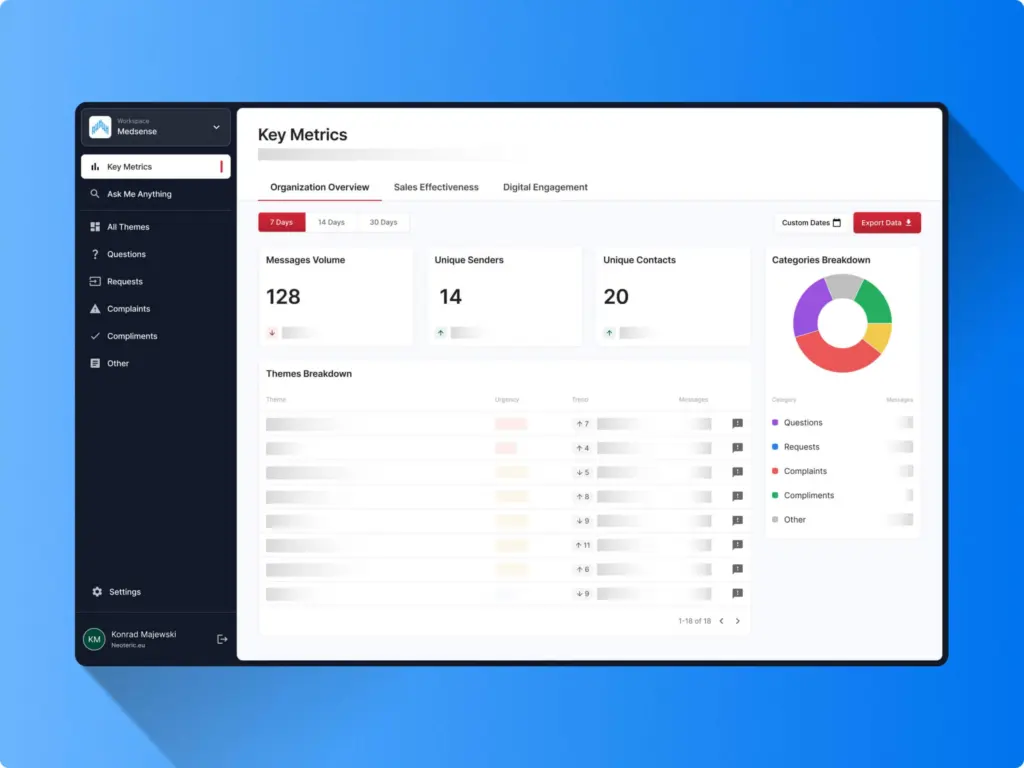
A generative AI platform for patient engagement
Prepared for launch in eight months
For a healthcare technology client, we developed a SaaS platform designed to reveal useful insights from patient interactions and support operational workflows.
We created an evaluation framework for model outputs and iterated on the results before preparing the platform for launch. The project combined product delivery with task-specific AI validation.
Read more
A digital system for an IVF medical group
We designed a scalable custom system for a group of European IVF clinics and fertility centers. The scope included electronic medical protocols, appointment scheduling, a multilingual chatbot, CRM integration, and custom reporting.
The system was designed around patient management and the operational needs of the clinics.
“Excellent code quality and work ethics.”
CTO, Mental Health Platform · Read the case study

Where could AI help your organization?
These are potential use cases to explore and validate against your data, workflows, and success criteria.

Prepare for appointments
Collect medical history, current medications, and patient questions before a visit. Give care teams a structured summary to review ahead of the consultation.

Make knowledge easier to find
Use retrieval-augmented generation to help professionals search approved medical resources, with source references and a clear review process.
Plan capacity and resources
Explore forecasts for service demand and identify patterns that can inform staffing, scheduling, and operational decisions.

Support specialist workflows
Assess computer vision and risk-flagging tools for defined clinical tasks. Establish expert oversight, evaluation criteria, and the intended use before moving beyond a prototype.

Develop staff skills
Explore personalized training recommendations, progress tracking, and reminders for certification renewals.
Build around the realities of healthcare
Technical feasibility is only one part of a successful product. During discovery, we work with your team to define the requirements that shape delivery.
- Data and access: map the information the product needs, who can use it, and how it should be protected.
- Integration: assess existing systems, APIs, and the workflows the new product must support.
- Validation: agree on representative test data, meaningful performance measures, and human review points.
- Intended use: clarify clinical responsibilities and applicable regulatory requirements with your domain and compliance specialists.
A clear route from opportunity to implementation
Start at the stage that fits your product’s maturity. Each phase should provide the evidence needed to decide what comes next.

1. Discover and prioritize
Introduce your goals and constraints, then use an AI Exploratory Workshop to identify use cases, define success criteria, and prioritize by impact and complexity.
Explore AI workshops2. Validate and build an MVP
Use a proof of concept to test technical feasibility and business value. Develop the core product, gather user feedback, and assess performance in its intended workflow.

3. Integrate, scale, and maintain
Expand validated capabilities, connect additional systems, and improve the product as needs evolve. Plan ongoing support, performance optimization, and security updates.
Healthcare software development: your questions
Can you help us choose the right AI use case?
Yes. We start with your organization’s goals, data, and workflows. An exploratory workshop helps compare opportunities, define success criteria, and choose what to validate first.
Can you work with our existing healthcare software?
We assess your current architecture, available APIs, data flows, and access requirements before planning integrations. Our experience includes projects involving existing apps, CRM systems, scheduling, and medical protocols.
Do we need to commit to a full product immediately?
No. A focused proof of concept can test the riskiest assumptions before a larger investment. Its scope and success criteria are agreed around the specific use case.
How do you validate AI for healthcare applications?
We define task-specific evaluation criteria, test against relevant data, and establish review points with domain experts. Clinical validation and any regulatory pathway depend on the product’s intended use and must be addressed as part of its delivery plan.
Can you support the product after launch?
Yes. We provide maintenance and further development, including bug fixes, security updates, performance improvements, and new functionality based on user feedback.
Let’s find your next step in healthcare technology
Tell us about your patients, care teams, and business goals. We will help you decide what to validate, what to build, and how to move forward.
Discuss your healthcare project