Building a custom platform for the biggest online yoga studio in Poland
Yoga Portal
About the project
When we started the project, PortalYogi was already the biggest online community for yoginis in Poland. They were big enough to feel the constraints of the available off-the-shelf solutions for fitness providers.
With a strong need to meet the expectations of their clients and the ambition to scale their business, they decided to build a custom yoga platform. To approach it right and make sure we focus on the right features, we decided to run a Discovery Workshop – a meeting where we analyze clients’ vision, goals, pain points, and requirements to help them create a product backlog and prioritize the features. The workshop helps us align project scope with the deadlines and make sure that the product’s end-users are getting value from the very beginning.
Our tasks

Setting the scope for an MVP
Working on an MVP, we want to bring a product to the market as fast as possible. For that, we need clear priorities.

Building a long-term product strategy
It is equally important, though, to stay aware of what comes next. For that, we need a vision of what the ideal product should be.

Running user interviews & usability tests
What’s most important, however, is to make sure that the assumptions we have are correct. And who knows best what the ideal product should be? End-users.
01
Challenges
Increasing user retention in an online yoga studio
Overcoming the limitations of the Teachable platform
Gaining independence and growing business in a sustainable way

Within months, Neoteric met internal standards of quality and efficiency. The agency’s deep open-source knowledge, meticulous documentation, and fluid onboarding capabilities add to their value. They are dexterous and skillful enough to handle a project end-to-end, making them an integral partner.

Marzena Jaworska / CEO & Co-owner of PortalYogi
Source: Clutch.co
02
Approach
Building Value Proposition Canvas
To ensure that the new platform responds to the pains and gains of the end-users, we’ve built a Value Proposition Canvas for two types of users: customers and admins. Thus, if any of the intended features would not be a pain reliever or a gain creator, we would know it’s not the right time to build it at the MVP stage.
Designing low-fi mockups
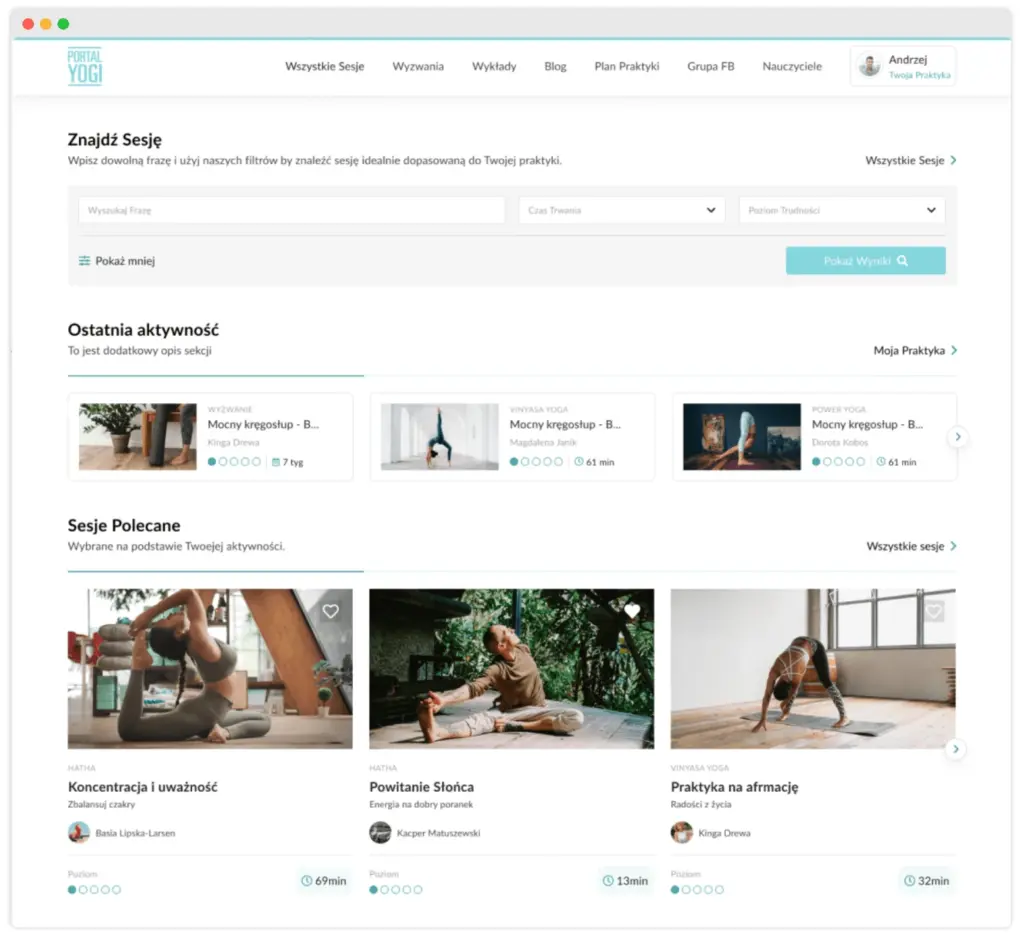
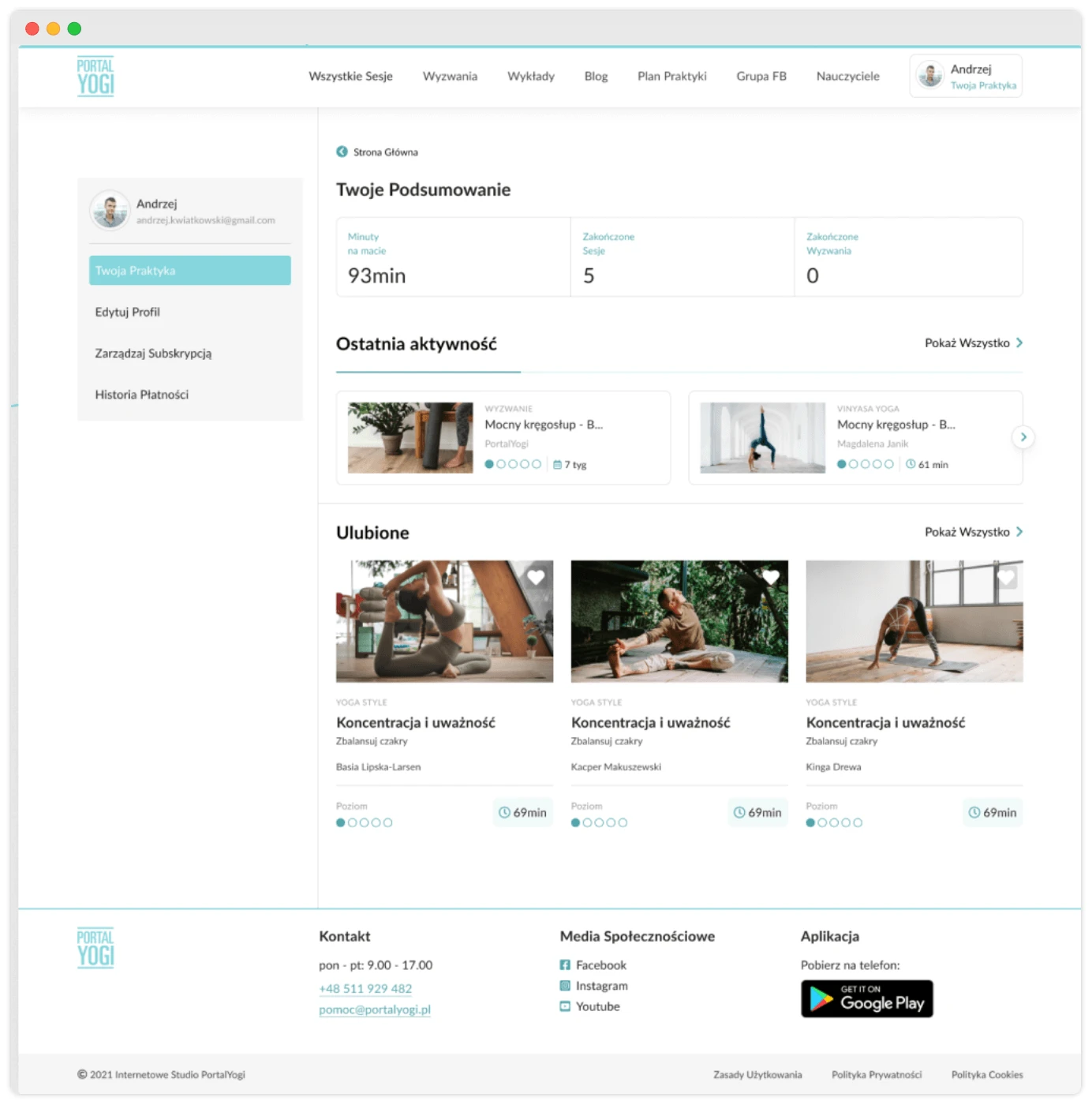
We’ve learned a lot during the first two days of the workshops. We discussed the business model, analyzed client personas, went through industry benchmarks, and brainstormed the potential features. It was high time to design some low-fidelity mockups that we could use to confront our ideas with users. At this stage, we decided to design three core screens: the homepage of the platform with a search feature and a content overview, a page with the search results and filters that can be applied, and a user panel with some practice history & statistics, favorite videos and playlists.
Running user interviews and usability tests before the MVP phase
User interviews consisted of two parts: individual in-depth interviews and moderated usability tests. In the first part, we wanted to learn why our interviewees practiced yoga, what motivated them, what helped them stick to their routines, and what stopped them from doing it. In the second part, we presented them with our prototype mockups, giving them some simple tasks and asking what they saw and how they liked it. Apart from learning how the users like our prototype, we wanted to know if it’s intuitive and easy to use.
Technology we used

Miro

Google Meet

Figma

PWA

Node.js

NestJS

React
03
Project Results

Decreasing user churn related to the platform’s usability by 10x
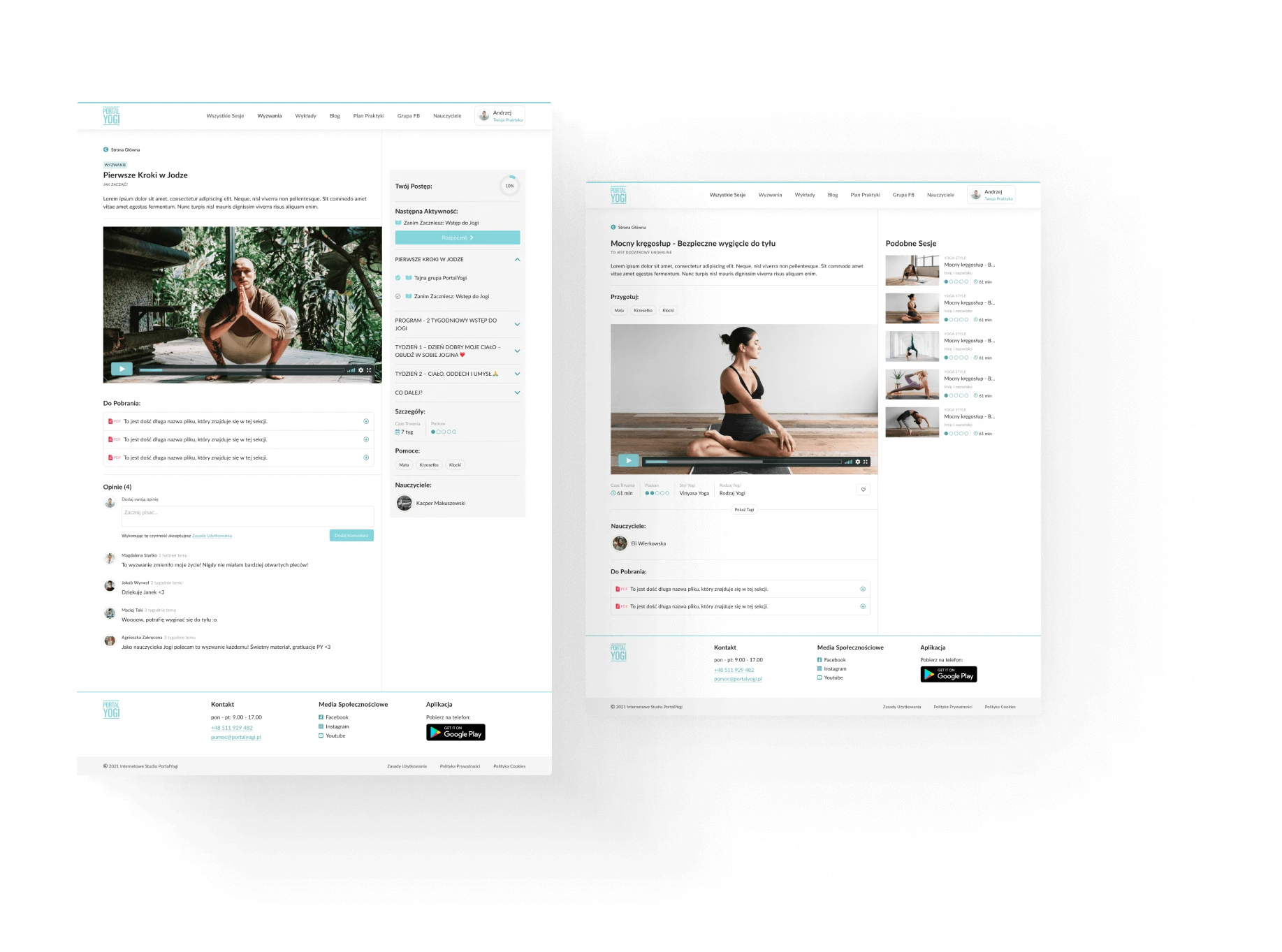
By improving the platform’s usability, we made it more accessible for the users. The existing content is now easier to discover, and the analysis of the churn reasons showed that 10x fewer users drop off because of UX-related reasons.
Setting the foundation for growth
One year after migration, the new platform has twice as many users as before. While this success is the result of the tremendous efforts of the whole PortalYogi team, creating great content and running well-thought campaigns, it would be hard to achieve it on the old platform.
Creating a long-term product strategy
Even though we were focused on finding the simplest way to give PortalYogi users the most value, we did not lose sight of the long-term goal. In order to align the product with the business strategy, we planned the platform’s architecture in a way that would allow the client to scale it up in the future.
Conclusion